
Mostrando entradas con la etiqueta Glenn Gould. Mostrar todas las entradas
Mostrando entradas con la etiqueta Glenn Gould. Mostrar todas las entradas
viernes, 20 de noviembre de 2015
A new profession -- in classical music?
Well, you know that many new and prosperous professions nowadays didn't exist like 10 years ago, such as social media manager (or consultant) or anything to do with mobile phones and apps. That's how I feel now in Indonesia as a (classical music) composer. My European colleagues who are reading this might feel strange .... but yeah, classical music, in spite of its term, is something new to us Indonesians, starting from the second half of the last century. We do have pioneers of classical music composers, such as Amir Pasaribu (who died a few years ago with 92 years of age, after around 30 or more years of his last years not composing anything) or, still very much around us, the 80-year-young Trisutji Kamal. But now that the classical music scene is so robust in Indonesia, I am working with so many young (and not so young too) musicians who are playing my music, either as part of their educational purposes or with the intention of performing it professionally. .............................................................................................................................................
Before this, classical musicians are faced with music by dead composers only. You have all the materials provided, besides the music sheet. Now with the existence of youtube, you can even have all the historical recordings, you name it, Glenn Gould, Artur Rubinstein even going back to the recording of the composers themselves such as Rachmaninov or Prokofiev playing their own music (which sometimes are not so brilliant as other pianists performing their music. Even Rachmaninov admitted that about Vladimir Horowitz, as you know). So, you pick a Bach French Suite and you can listen to a few hundred different recordings, most of them artistically of high quality. You choose the best according to you, or the one you feel closest too, and there you get a clear concept of the music. You might not be able to imitate it (who could imitate Gould?), but you work on that piece of music with the sound of your favorite recording in your head, but mostly not your own idea. So, you are already conditioned to a specific interpretation of the music, not the music itself. .............................................................................................................................................
With newly written music, you are demanded to have a clear idea YOURSELF of the musical concept and its character. It's perhaps (a bit) easier if you are a singer, since you have the words to start with, although sometimes a poem could be so complex that it's the music that helps you feel the atmosphere between the words. But if it's a piece of instrumental music, well, it does need your musical sensitivity to grasp its idea. .............................................................................................................................................
This is why a new piece of music is very important in music competitions. It's much easier to perform a piece of music that has a "history" ---and like any history, it has so many different versions--- but it is through an interpretation of a really new piece of music that we can really see the artistic abilities of a musician. Nowadays we don't need more musicians who can read notes so well and play it with the nimblest of fingers; it is already expected from any musician. We need musicians who understand what lies between those notes, even though (s)he has never heard that music before. .............................................................................................................................................
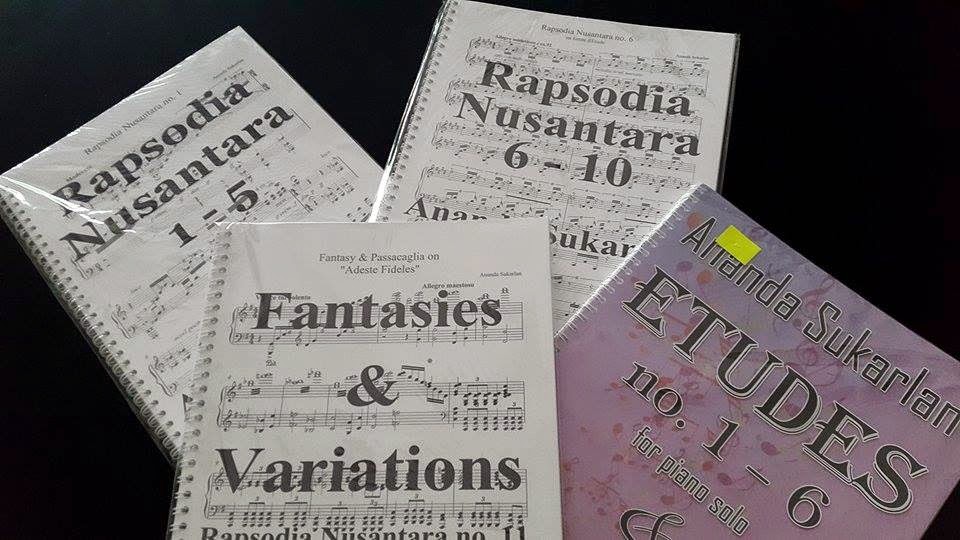
So, for you who are performing my piano pieces in the next Ananda Sukarlan Award competition, you might have acquired my newest CD, A Virtuosic Christmas. I play some of the works that you could choose among the obligatory works to play there. But remember, I am counting on YOU to play it better. You've gotta be able to see other points of views, other ideas, other musical concept of it. I played it as an INTERPRETER, not as a composer anymore, as any pianist-composer could tell you when they are performing their own works. I have heard my music performed differently than I had in mind before, and many times. And some of them, I must say, are excellent. There are fresh approaches in some pieces on Henoch Kristianto's recordings of some of my Rapsodia Nusantara, and some performances of Edith Widayani were also more than artistically very admirable. And I must say that until now, nobody (I include myself here) matches the brilliance of Anthony Hartono's performance of Rapsodia Nusantara no. 10. I am just sooo much looking forward to hearing a mindblowing performance of some of my works in the next competition next July. 

martes, 17 de febrero de 2015
All That Jazz
Most of you might have noticed that when I am asked the emblematic question "who's your favorite pianist" I always had difficulties in answering it. Naturally, the unmentioned word in that question is "classical" that comes before the word "pianist". Well, it's because I don't really have one, to tell you the truth. My idols are mostly jazz pianists, and even those who have passed away. I am a big fan of Art Tatum, Fats Waller, Chick Corea and Friedrich Gulda. The classical pianist whom I admire until now are even the not-so-common (or "classical") ones, such as Gulda as I mentioned, Glenn Gould, Andre Previn and Leonard Bernstein. I just can't mention the usual stereotypes of academic, "refined" classical pianists as my idol ... and of course it's my problem. There are of course incredibly brilliant ones, but I just don't listen to them anymore. Yeah I did when I was younger, but not now. .............................................................................................................................................
In Indonesia, classical pianists are a kind of new race that started to inhabit our country very recently. When I was small, of course there were classical pianists, but none that could impress me, or therefore any other people. Of course there was Yazeed Djamin (1951-2001) who studied in the US, who inspired me in many ways. He was by far the most charismatic, and most brilliant. The others who studied abroad were more dedicated to teaching, like our pioneer Mrs. Latifah Kodijat (born in 1928, she was perhaps the first piano teacher in Indonesia, if I may say so), Pujiwati Effendi, Trisutji Kamal (who composed much more than teaching, luckily, to be able to contribute to the repertoire of Indonesian classical music of that period that was really scarce) and my teachers Soetarno Soetikno, Rudy Laban and then the younger generations. .............................................................................................................................................
Therefore, the ones who really performed regularly during my childhood and teenage period were the jazz pianists. And among them, I put two of them on a high pedestal : Nick Mamahit and the younger Hendra Wijaya, this latter is more famous in his virtuosic ragtimes. I cherish those hours before I slept as a teenager listening to Hendra Wijaya playing Tiger Rag, Tico Tico etc with the Ireng Maulana All Stars. And Nick Mamahit was important for me coz it was from him that I listened to the Indonesian folk music, improvised in his characteristic jazz style. Who would imagine that ages later I would do the same with my Rapsodia Nusantara, and in classical style? In fact, this last Rapsodia Nusantara I finished writing a few days ago is just so jazzy from beginning to end, meaning that it is full of blue chords and funky syncopes . .............................................................................................................................................
Of course I would definitely say that to start learning the piano, the classical techniques are always the best for everyone. We learn how to play scales, arpeggios, chords etc. properly from the music of Mozart, Chopin, Liszt and Prokofiev etc. They laid the foundations of piano playing, not only in classical style but also in jazz. But then we should remember that all those composers were IMPROVISERS too, and it was only at the second half of the 20th century existed a clear difference between a pianist (or interpreter of instruments of any kind) and composers. The only genre of music where musicians create something fresh on stage since then was in jazz. And yeah, there were jazz players who reeeeeally developed the classical techniques. I remember how Hendra Wijaya played Tico Tico, and I dare to say that he wouldn't be able to do it if he didn't practice his Mozart Sonatas in his younger years. But then he brought that Mozartian technique to an incredible speed! .............................................................................................................................................
When the International Java Jazz organizers invited me to perform in their festival next March, I immediately accepted it. I wanna show the public, that without Nick Mamahit, Hendra Wijaya and many of international jazz pianists whom I highly admire I wouldn't be able to write many of my music. My concert at Java Jazz would then be a tribute to my heroes. They inspired me when I was young, they still stay in my memories now. ............................................................................................................................................. If you wanna come to my concert at Java Jazz, I'll be playing on their last day, Sunday March 8th at 3.30 p.m. You still can enjoy the beautiful sunset afterwards, and have a nice dinner with your partner. You got no partner? Well, you might find one in my concert! C u all there, folks!
. .............................................................................................................................................
Of course I would definitely say that to start learning the piano, the classical techniques are always the best for everyone. We learn how to play scales, arpeggios, chords etc. properly from the music of Mozart, Chopin, Liszt and Prokofiev etc. They laid the foundations of piano playing, not only in classical style but also in jazz. But then we should remember that all those composers were IMPROVISERS too, and it was only at the second half of the 20th century existed a clear difference between a pianist (or interpreter of instruments of any kind) and composers. The only genre of music where musicians create something fresh on stage since then was in jazz. And yeah, there were jazz players who reeeeeally developed the classical techniques. I remember how Hendra Wijaya played Tico Tico, and I dare to say that he wouldn't be able to do it if he didn't practice his Mozart Sonatas in his younger years. But then he brought that Mozartian technique to an incredible speed! .............................................................................................................................................
When the International Java Jazz organizers invited me to perform in their festival next March, I immediately accepted it. I wanna show the public, that without Nick Mamahit, Hendra Wijaya and many of international jazz pianists whom I highly admire I wouldn't be able to write many of my music. My concert at Java Jazz would then be a tribute to my heroes. They inspired me when I was young, they still stay in my memories now. ............................................................................................................................................. If you wanna come to my concert at Java Jazz, I'll be playing on their last day, Sunday March 8th at 3.30 p.m. You still can enjoy the beautiful sunset afterwards, and have a nice dinner with your partner. You got no partner? Well, you might find one in my concert! C u all there, folks!
jueves, 2 de diciembre de 2010
You talkin' to me??
These are some questions & answers that I found scattered around in my emails with journalists, students who are doing research about my music (and me), etc. Thought they would be useful to you.
1. I know that you don't perform much now. but is there any advice for performance anxiety?
An unfortunate answer : NO. Even if one is so so prepared, it happens still ! And different kind of symptoms could happen to different kinds of people : I have the same one as Benjamin Britten's (he was famous for his rituals!) : stomach problems before going on stage.
2. Are there any advices for those who want to make career in performing and composing music?
Well, unfortunately I can't think of any other way but to join & win the competitions, although competitions are so so inartistic . But for me, it was the way. Afterwards I started to re-educate myself musically (meaning , playing for artistic reasons, and not to please the jury. Not even the audience; I do it for the music, which is sometimes too honest to please anyone ) .
3. What is "good music", according to you?
Simple. Good music is that which is always better than its performance(s). While not so good ones depend so much on their performers. I'll put it simpler: imagine Beethoven's Sonatas, or Bach's Well Tempered Klavier or Gustav Mahler's Symphonies. I believe that noone, NOBODY, until now can reach the height of their real quality. And I am a big fan of Glenn Gould's Bach performances and Leonard Bernstein's repeated renderings of Mahler! And there is even a better evidence for this : Rachmaninov as a pianist of his own works repeatedly did performances of the same pieces in different interpretations throughout the years. He, I consider, was the greatest pianist of the history (well I never heard recordings of Liszt!), but he was a step under his greatness as a composer.
That automatically explains my music : I am desperately counting on good performers to make my music better than it is!!
4. From which composers do you learn the most?
From almost everyone, even though it means I learned what I should NOT do in composition. That's why I am interested in "bad" (according to me) composers too (mostly contemporary ones). You can even learn from the hour long Mahler symphony to apply it in a very short piece, or from a complex orchestration of Britten for writing a, say, trio or quartet. Anyway, I do admit that there are "fixed" composers, such as Bach, Britten, Mahler and Stravinsky to turn to every time I got compositional problems (and even blocks, which happen not seldomly.
5. Could you share any visions / plans in the future?
Have you read about Mozart wanting only to write operas and nothing else? Well, I am like that. If I can, I would only write operas and more operas. But it poses a lot of problems, mostly economic ones. And it's so complicated to produce! And I feel that through operas we can express our preoccupations about things like human rights etc . Do you know Stravinsky's saying "Music is unable to express anything " ? Noooo way ! It is so powerful to express, but what is expressed cannot be done in words. Not even in an opera; it is the music, not the words, that reaches directly to the heart of the listener. And it hurts, sometimes.
1. I know that you don't perform much now. but is there any advice for performance anxiety?
An unfortunate answer : NO. Even if one is so so prepared, it happens still ! And different kind of symptoms could happen to different kinds of people : I have the same one as Benjamin Britten's (he was famous for his rituals!) : stomach problems before going on stage.
2. Are there any advices for those who want to make career in performing and composing music?
Well, unfortunately I can't think of any other way but to join & win the competitions, although competitions are so so inartistic . But for me, it was the way. Afterwards I started to re-educate myself musically (meaning , playing for artistic reasons, and not to please the jury. Not even the audience; I do it for the music, which is sometimes too honest to please anyone ) .
3. What is "good music", according to you?
Simple. Good music is that which is always better than its performance(s). While not so good ones depend so much on their performers. I'll put it simpler: imagine Beethoven's Sonatas, or Bach's Well Tempered Klavier or Gustav Mahler's Symphonies. I believe that noone, NOBODY, until now can reach the height of their real quality. And I am a big fan of Glenn Gould's Bach performances and Leonard Bernstein's repeated renderings of Mahler! And there is even a better evidence for this : Rachmaninov as a pianist of his own works repeatedly did performances of the same pieces in different interpretations throughout the years. He, I consider, was the greatest pianist of the history (well I never heard recordings of Liszt!), but he was a step under his greatness as a composer.
That automatically explains my music : I am desperately counting on good performers to make my music better than it is!!
4. From which composers do you learn the most?
From almost everyone, even though it means I learned what I should NOT do in composition. That's why I am interested in "bad" (according to me) composers too (mostly contemporary ones). You can even learn from the hour long Mahler symphony to apply it in a very short piece, or from a complex orchestration of Britten for writing a, say, trio or quartet. Anyway, I do admit that there are "fixed" composers, such as Bach, Britten, Mahler and Stravinsky to turn to every time I got compositional problems (and even blocks, which happen not seldomly.
5. Could you share any visions / plans in the future?
Have you read about Mozart wanting only to write operas and nothing else? Well, I am like that. If I can, I would only write operas and more operas. But it poses a lot of problems, mostly economic ones. And it's so complicated to produce! And I feel that through operas we can express our preoccupations about things like human rights etc . Do you know Stravinsky's saying "Music is unable to express anything " ? Noooo way ! It is so powerful to express, but what is expressed cannot be done in words. Not even in an opera; it is the music, not the words, that reaches directly to the heart of the listener. And it hurts, sometimes.
miércoles, 14 de julio de 2010
Looking forward, and Foreword to Ananda Sukarlan Award 2010
This time my entry is in Indonesian, which is the foreword for ASA 2010.
"Music is the food of love" (William Shakespeare).
"Like food, if it's instant, it is junk" (Ananda Sukarlan)
Ananda Sukarlan Award 2010 kembali kami selenggarakan di tengah keadaan yang serba instan yang semakin marak. Ketenaran dan karir yang diraih langsung dari atas adalah ciri khas "seni" pertunjukan saat ini di Indonesia. Sayang sekali banyak yang lupa, jika anda mendarat langsung di puncak gunung, jalan satu-satunya yang ada hanyalah kebawah. Saya tidak pernah percaya ramalan baik Joyoboyo maupun Nostradamus, tapi saya hanya selalu percaya pada satu ramalan saja, yaitu dari seniman Andy Warhol di tahun 70-an: "In the future, everybody will be famous for 15 minutes". Dan hal itu sedang dalam proses realisasinya, baik berkat siaran-siaran TV dari Amerika Serikat yang menjanjikan ke"seniman"an dalam beberapa bulan sampai penawaran predikat "terbaik", "terbanyak" dan banyak ter- lainnya yang harganya lebih murah daripada sebuah mobil termurah pun. Masih terus terngiang-ngiang di telinga kita persembahan Glenn Gould memainkan Goldberg Variations dari tahun 70-an, atau konser terakhir Leonard Bernstein yang legendaris mengekspresikan Four Sea Interludes dari Benjamin Britten di tahun 1990. Tapi saat ini sebuah kejadian atau kreasi seni penting, betapapun tinggi nilai artistiknya, betapapun besar karya seninya, hanya akan terkenang selama sebuah status facebook belum diganti. Tidak ada lagi misteri dan ambiguitas lagi di dalam sebuah karya seni, karena semua misteri kini bisa dipecahkan lewat google.
Saya merasa sangat terharu bahwa ada sekitar 60 (dan pasti lebih lagi diluar ini) peserta ASA 2010 yang masih percaya akan jalan yang sulit dan berliku-liku dan "kuno" dalam dunia seni, khususnya musik sastra. Jalan tradisional inilah yang saya yakin akan menempa mereka menjadi seniman sejati yang mengerti liku-liku dunia ini, yang mau belajar dari kesalahan, yang mau menerima kritik dan kekurangan untuk memperbaikinya, yang mau jatuh berkali-kali tapi bangun berkali-kali lagi. Tidak ada kata "kalah" dalam dunia seni, tidak ada kata "salah" dalam berkespresi. Yang ada hanyalah introspeksi dan kerja keras yang terus menerus untuk mencapai puncak yang tidak akan bisa diraih oleh manusia manapun di planet ini, yang bernama "kesempurnaan".
Saya ingin mengucapkan selamat kepada para peserta ASA 2010. Dan juga rekan-rekan juri yang terdiri dari musikus-musikus yang sangat saya hormati dan kagumi yang punya kepercayaan yang sama dengan saya, terima kasih sedalam-dalamnya saya ucapkan. Tuhan memberkati anda dalam berkompetisi dengan anda sendiri untuk menjadi anda yang lebih baik di masa depan.
Pianistically yours,
Ananda Sukarlan
www.musik-sastra.com
"Music is the food of love" (William Shakespeare).
"Like food, if it's instant, it is junk" (Ananda Sukarlan)
Ananda Sukarlan Award 2010 kembali kami selenggarakan di tengah keadaan yang serba instan yang semakin marak. Ketenaran dan karir yang diraih langsung dari atas adalah ciri khas "seni" pertunjukan saat ini di Indonesia. Sayang sekali banyak yang lupa, jika anda mendarat langsung di puncak gunung, jalan satu-satunya yang ada hanyalah kebawah. Saya tidak pernah percaya ramalan baik Joyoboyo maupun Nostradamus, tapi saya hanya selalu percaya pada satu ramalan saja, yaitu dari seniman Andy Warhol di tahun 70-an: "In the future, everybody will be famous for 15 minutes". Dan hal itu sedang dalam proses realisasinya, baik berkat siaran-siaran TV dari Amerika Serikat yang menjanjikan ke"seniman"an dalam beberapa bulan sampai penawaran predikat "terbaik", "terbanyak" dan banyak ter- lainnya yang harganya lebih murah daripada sebuah mobil termurah pun. Masih terus terngiang-ngiang di telinga kita persembahan Glenn Gould memainkan Goldberg Variations dari tahun 70-an, atau konser terakhir Leonard Bernstein yang legendaris mengekspresikan Four Sea Interludes dari Benjamin Britten di tahun 1990. Tapi saat ini sebuah kejadian atau kreasi seni penting, betapapun tinggi nilai artistiknya, betapapun besar karya seninya, hanya akan terkenang selama sebuah status facebook belum diganti. Tidak ada lagi misteri dan ambiguitas lagi di dalam sebuah karya seni, karena semua misteri kini bisa dipecahkan lewat google.
Saya merasa sangat terharu bahwa ada sekitar 60 (dan pasti lebih lagi diluar ini) peserta ASA 2010 yang masih percaya akan jalan yang sulit dan berliku-liku dan "kuno" dalam dunia seni, khususnya musik sastra. Jalan tradisional inilah yang saya yakin akan menempa mereka menjadi seniman sejati yang mengerti liku-liku dunia ini, yang mau belajar dari kesalahan, yang mau menerima kritik dan kekurangan untuk memperbaikinya, yang mau jatuh berkali-kali tapi bangun berkali-kali lagi. Tidak ada kata "kalah" dalam dunia seni, tidak ada kata "salah" dalam berkespresi. Yang ada hanyalah introspeksi dan kerja keras yang terus menerus untuk mencapai puncak yang tidak akan bisa diraih oleh manusia manapun di planet ini, yang bernama "kesempurnaan".
Saya ingin mengucapkan selamat kepada para peserta ASA 2010. Dan juga rekan-rekan juri yang terdiri dari musikus-musikus yang sangat saya hormati dan kagumi yang punya kepercayaan yang sama dengan saya, terima kasih sedalam-dalamnya saya ucapkan. Tuhan memberkati anda dalam berkompetisi dengan anda sendiri untuk menjadi anda yang lebih baik di masa depan.
Pianistically yours,
Ananda Sukarlan
www.musik-sastra.com
Suscribirse a:
Entradas (Atom)