Mostrando entradas con la etiqueta Yazeed Djamin. Mostrar todas las entradas
Mostrando entradas con la etiqueta Yazeed Djamin. Mostrar todas las entradas
martes, 17 de febrero de 2015
All That Jazz
Most of you might have noticed that when I am asked the emblematic question "who's your favorite pianist" I always had difficulties in answering it. Naturally, the unmentioned word in that question is "classical" that comes before the word "pianist". Well, it's because I don't really have one, to tell you the truth. My idols are mostly jazz pianists, and even those who have passed away. I am a big fan of Art Tatum, Fats Waller, Chick Corea and Friedrich Gulda. The classical pianist whom I admire until now are even the not-so-common (or "classical") ones, such as Gulda as I mentioned, Glenn Gould, Andre Previn and Leonard Bernstein. I just can't mention the usual stereotypes of academic, "refined" classical pianists as my idol ... and of course it's my problem. There are of course incredibly brilliant ones, but I just don't listen to them anymore. Yeah I did when I was younger, but not now. .............................................................................................................................................
In Indonesia, classical pianists are a kind of new race that started to inhabit our country very recently. When I was small, of course there were classical pianists, but none that could impress me, or therefore any other people. Of course there was Yazeed Djamin (1951-2001) who studied in the US, who inspired me in many ways. He was by far the most charismatic, and most brilliant. The others who studied abroad were more dedicated to teaching, like our pioneer Mrs. Latifah Kodijat (born in 1928, she was perhaps the first piano teacher in Indonesia, if I may say so), Pujiwati Effendi, Trisutji Kamal (who composed much more than teaching, luckily, to be able to contribute to the repertoire of Indonesian classical music of that period that was really scarce) and my teachers Soetarno Soetikno, Rudy Laban and then the younger generations. .............................................................................................................................................
Therefore, the ones who really performed regularly during my childhood and teenage period were the jazz pianists. And among them, I put two of them on a high pedestal : Nick Mamahit and the younger Hendra Wijaya, this latter is more famous in his virtuosic ragtimes. I cherish those hours before I slept as a teenager listening to Hendra Wijaya playing Tiger Rag, Tico Tico etc with the Ireng Maulana All Stars. And Nick Mamahit was important for me coz it was from him that I listened to the Indonesian folk music, improvised in his characteristic jazz style. Who would imagine that ages later I would do the same with my Rapsodia Nusantara, and in classical style? In fact, this last Rapsodia Nusantara I finished writing a few days ago is just so jazzy from beginning to end, meaning that it is full of blue chords and funky syncopes . .............................................................................................................................................
Of course I would definitely say that to start learning the piano, the classical techniques are always the best for everyone. We learn how to play scales, arpeggios, chords etc. properly from the music of Mozart, Chopin, Liszt and Prokofiev etc. They laid the foundations of piano playing, not only in classical style but also in jazz. But then we should remember that all those composers were IMPROVISERS too, and it was only at the second half of the 20th century existed a clear difference between a pianist (or interpreter of instruments of any kind) and composers. The only genre of music where musicians create something fresh on stage since then was in jazz. And yeah, there were jazz players who reeeeeally developed the classical techniques. I remember how Hendra Wijaya played Tico Tico, and I dare to say that he wouldn't be able to do it if he didn't practice his Mozart Sonatas in his younger years. But then he brought that Mozartian technique to an incredible speed! .............................................................................................................................................
When the International Java Jazz organizers invited me to perform in their festival next March, I immediately accepted it. I wanna show the public, that without Nick Mamahit, Hendra Wijaya and many of international jazz pianists whom I highly admire I wouldn't be able to write many of my music. My concert at Java Jazz would then be a tribute to my heroes. They inspired me when I was young, they still stay in my memories now. ............................................................................................................................................. If you wanna come to my concert at Java Jazz, I'll be playing on their last day, Sunday March 8th at 3.30 p.m. You still can enjoy the beautiful sunset afterwards, and have a nice dinner with your partner. You got no partner? Well, you might find one in my concert! C u all there, folks!

viernes, 18 de septiembre de 2009
Yeah the title isn't mine, but the music is !
Just realized I haven't blogged for over a month, eh? So here I am again. When I was in Indonesia last month I got another negative comment about my Rapsodia Nusantara : the usual phrase that it is not my music but an Indonesian folk-tune instead. Well, it is ! Let me tell you how it works, for the n-th (and hopefully the last!) time :
The idea of "Rapsodia" (let's call it RN since now, although it sounds like another flu virus spread by Donald Rumsfeld's company) was first mentioned by my late friend, composer Yazeed Djamin. He wanted to do a series of RN (the title was HIS idea) for me, for piano solo, so that I could have a series of Indonesian virtuosic piano works and at the same time introduce Indonesian folk-tunes in my concerts. Until then (he died in 2001) there weren't any really virtuosic piano works by an Indonesian composer, can you imagine ? I mean, those ones that could bring the house down as the closing piece of a concert. Now, this idea itself is not original : it was inspired by (what else?) Liszt's Hungarian Rhapsodies. If you now go to Hungary and hear some familiar folktunes, well you can be thankful to our old friend Ferenc who introduced them to you by incorporating them (or using them as material) in his Rhapsodies. And Yazeed's (and my) argument was : why do we Indonesians always end our concerts with Hungarian Rhapsodies ? Why don't we make our OWN Rhapsodies ?
Liszt's case wasn't the first, nor the last time that composers "steal" from folk-tunes. It goes back to the 16th century and maybe before. You can hear them in works of Sweelinck, Rameau and Mozart. The extreme case are those pieces called "Rumanian (and Bulgarian) Folk Dances" by Bela Bartok, as if HE was the composer of those folk dances. Now what, would you point your finger to him again and say that he cheated ?
Guys, it's not the material that counts. It's the development of it, it's what you do with the material. It's like saying "When life gives you lemon, make lemonade". Materials (it's cooler for artists to say "inspiration") could be found everywhere; even you can DEFINE a material in words (such as "three short notes and one long note" for Beethoven's Fifth). It's like a grape, which you can just eat as it is, or turn into very refined wine. And yeah, wine IS grape ! Who said it's not? So, d'you get it now that I am not trying to boldly write music which no man has written before?
Anyway, you won't say that those running octaves and crazy arpeggios are not mine, right ? You say they belong to folkmusic, and many people would be dead trying to sing them !
So, enough of that. I am writing --to be precise, trying to write-- my third opera at the moment. Usually I love writing operas, but it is now a different issue. There will be no real strong protagonist in this opera ; at least 8 singers would be a soloist in a certain moment. The difficulty is that I don't have those singers in mind. I always have this wishful thinking that my music would still be around after I die, and they will be played and sung by musicians that I won't be acquainted personally, but at the time of writing the music, the figure of the musician in the back of my head really does help in making the shape of the music. One of my greatest pleasures in writing music was when I wrote a series of duos (for violin, bassoon, trumpet etc. with piano) for the handicapped people here in Spain : it was their handicap, and their love and enthusiasm to music that inspired the music that I wrote. And those duos can be (in fact, will mostly be) performed by any musician with complete limbs of the body. So it is not about the virtuosity or genius of the musician ; it is just themselves and each of their particular way of making music. Every person is special to me, and there is always an element in everyone that makes me fall in love with them, and therefore, be inspired by them. The proof is, everytime I wrote music for (a) certain musician(s) for the second time, it always turned out to be better !
miércoles, 19 de marzo de 2008
Why no "Sukarlan plays Sukarlan" ?
My manager Chendra Panatan has always been bombarded with this question (especially by many, many young pianists) : Why doesn't AS record and play his own piano music ? He's always answered with "Later perhaps", but now I will tell you the exact reasons why.
1. There are still not so many pianists who play my pieces, so I do not want to dictate them how to interpret my own music. Ok, ok, Rachmaninov as a pianist or Samuel Barber as a baritone were the best interpreters of their own music, but how many composers could claim it so? I am always surprised in listening to other people performing my music ; I always found new things which I even didn't realize before in my music. The good musicians always find new points of view in looking at the music. Don't misinterpret me as an idiot ! It's true, I tell you. It has happened also in the opposite way, when I am interpreting someone elses music. Sir Michael Tippett, Peter Sculthorpe and many others have expressed this to me (and in case of Sir Michael, God bless his soul, spoke it out loud on BBC Radio 3!) when they listened to my playing of their music.
2. You must understand that composing is one thing, being an interpreter is another thing. My interpretation of my own music doesn't make it more "authentic" than other (hopefully better) musician's interpretation. As a pianist, my position is exactly the same when I am playing Beethoven or when I am playing Ananda Sukarlan. The composer/conductor Andre Previn told me once that good music is always better than its performance. Therefore, nobody yet can achieve what Beethoven really wanted his music to sound. His music is still far better than any interpretations of it. In my case, it's the contrary : I am counting on my musicians to make my music sound BETTER than I wrote it !
3. I prefer at the moment to record music by other composers who I esteem highly. Especially now I am focusing myself on my Indonesian composers colleagues. Almost nobody cares about their music, and those who care, cannot play the piano ! Some of our senior composers such as Amir Pasaribu and Trisutji Kamal deserve to have recordings of their piano music NOW (to be precise, it's been long overdue). In case of the late Yazeed Djamin, there is also a feeling of friendship besides admiration. I am proud of their music, and I wish that Indonesian musicians could be proud of their composers. Who else but us, Indonesians, can introduce those composers ? They are not even known in our own country.
domingo, 4 de noviembre de 2007
Rapsodia Nusantara : Jakarta is no. 1
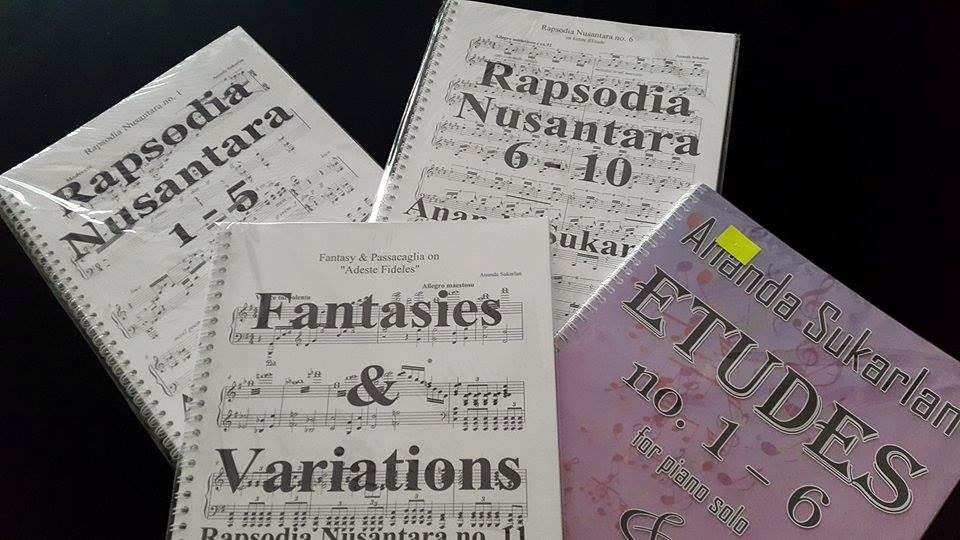
I stayed awake until 5 a.m this morning, finishing, revising and copying my First Rapsodia Nusantara—the first of a collection of Lisztian rhapsodies based on Indonesian folk tunes. In fact the idea of these rhapsodies came from conductor/composer/pianist Yazeed Djamin (1951-2001), with whom I often spoke about the identity of Indonesian classical music in general. The first piece will be premiered by myself in the concert to celebrate the newly elected governor of Jakarta, Fauzi Bowo who is a classical music lover and the dedicatee of the piece. It will also be the obligatory piece for the contestants of the Ananda Sukarlan Award, a piano competition founded by Mrs. Pia Alisjahbana (founder of Femina Group) and Mr. Dedi Panigoro (one of the founders and directors of the petroleum company MEDCO Energi). Besides this piece, I will also require the contestants to play another piece by another Indonesian composer, besides the standard repertory. Rapsodia Nusantara no. 1 is based on two folk tunes from Jakarta, “Kicir-Kicir” and “Jali-Jali.” It is also influenced by the inversion and retrograde techniques of Schoenberg, as well as Salvador Dali’s idea of the transformation of two elements. Like the Liszt rhapsodies, Rapsodia Nusantara (and those that follow) is meant to end a recital with virtuosity and flash. But for this one in particular I concentrate more in the different colours of the piano sounds, although certainly the piece doesn't lack virtuosity. I only enjoy listening to musicians who has a wide palette of sound colours, and that is what I would like to hear from the participants of the AS Award .
The Ananda Sukarlan Award for young pianists (under 26), by the way, will be held in Jakarta on the 24th- 27th of July 2008.
The Ananda Sukarlan Award for young pianists (under 26), by the way, will be held in Jakarta on the 24th- 27th of July 2008.
Suscribirse a:
Entradas (Atom)