sábado, 21 de marzo de 2015
A literary festival which is not only literary
It's been quite an inspiring half a week! The 2nd ASEAN Literary Festival was held in Jakarta, visited by literary figures from 20 countries. I am honoured to be invited to give a half-an-hour concert for the opening, which also include some poetry reading by Indonesian prominent poet Khrisna Pabichara and a speech by Dr. Ma Thida, a writer and human rights activist from Myanmar who spent many years in prison for "endangering public peace, having contact with illegal organisations, and distributing unlawful literature." ..............................................................................................................................................
The program director of this highly inspiring festival is Okky Madasari, the awardwinning writer famous for her novels about (the lack of) human rights. She designed this year's festival as a tribute to Sitor Situmorang, Indonesia's great poet who died less than 100 days ago. Since Sitor is one of my favorite poets, I have written a few songs based on his poems, but then I wrote a new one, (and a looong one by the way!) based on his masterpiece, La Ronde. It is one of the most erotic poems ever done in Indonesia literature, and written so subtly and exquisitely. It was in fact written for tenor and harp, since I felt that the harp represents more the sound that was triggered by the poem in my head, but unfortunately the young harpist partner of the tenor (Nikodemus Lukas, who sang so beautifully) had some examinations at those dates. Yeah, Jessica Sudarta the harpist is only 16, and her school makes her too busy. So I adapted the harp part for the piano and played it myself accompanying Niko. But they will record that work this year, so I am very much looking forward to it. Niko and I then perform my older songs based on poems by Sitor, and apparently many members of the audience made video recordings of them (yeah, it's so easy to do it nowadays!) and even uploaded them on youtube. This is one of them : https://www.youtube.com/watch?v=hZBQs9YVaa0 ..............................................................................................................................................
What made me happy about this is that at last the relationship between (classical) music and literature in Indonesia is now re-established. Since the death of composers such as Mochtar Embut and F.X. Sutopo (who wrote songs based on poems by W.S. Rendra etc) in the 1970s and 80s, these two artistic fields didn't meet anymore. I continued the tradition without even being aware that it was cut, since I live in Europe, where composers keep on composing based on existing poems or other literary forms since the 19th century (as you know, Franz Schubert and Robert Schumann were the pioneers in doing this). You might ask, what do we, composers, contribute to those poems that are already so highly expressive? Well, music enhances words with emotional energy that speech alone cannot convey. But obviously, there is more to it than this! We in Indonesia have a beautiful term for this art: Tembang Puitik (Poetic Song, which differentiates it from other songs whose texts are written by the songwriter himself). Therefore it strives to be the perfect combination of music and literature, based on four elements: poet, composer, singer and accompanist. The composer uses the full resources of the art form to embellish the poet's text, sometimes even realizing potential interpretations that were not explicit in the poet's words. In a well-realized Poetic Song, the composer creates a duet between the accompanist and the vocalist, so an accompanist's job is not merely "accompanying" with nice rhythms and chords. That is, the poetic song paints for us a picture of what the poet might have envisioned. The performance of an poetic song literally breathes life into this picture through a complementary, coordinated partnership among the four significant elements. ..............................................................................................................................................
Now I have written around 120 songs based on Indonesian poems, and another 60 or 70 on poems of Whitman, Browning and other foreign writers. In fact, I started to write those Indonesian songs in 2006 after having written many songs in English and Spanish, and now I feel really comfortable in composing on poems of my mother tongue. And I met new literary friends in this great festival, and I discovered the works by young writers such as Adimas Immanuel and Bernard Batubara so I am looking forward to write something based on their works. I also met long-time-no-see great poets Hasan Aspahani and Joko Pinurbo. ..............................................................................................................................................
My latest poetic songs are included in my CD "An Essay on Love", sung by Widhawan Aryo Praditha, Theodora Amabel Beatrice and Niko as well. If you are interested in it, please tweet me at @anandasukarlan .

viernes, 6 de marzo de 2015
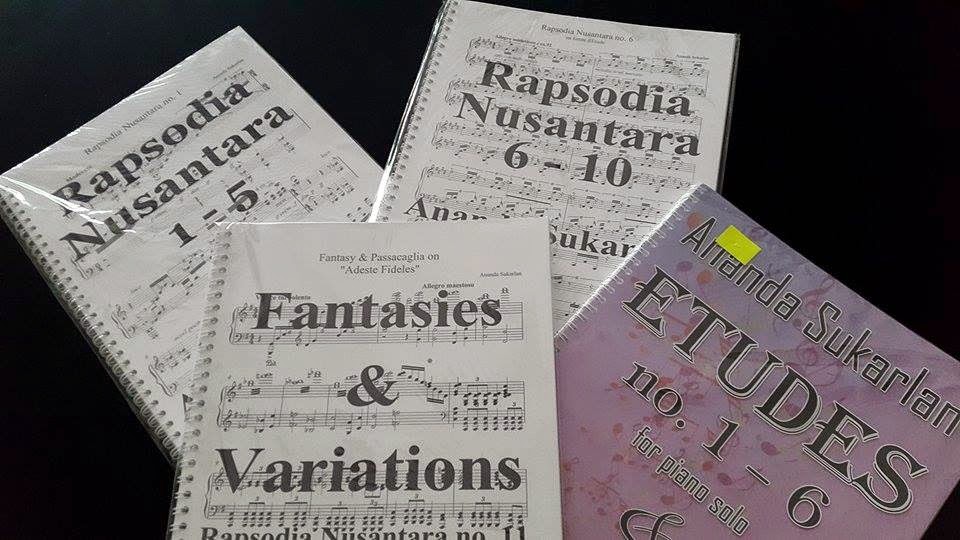
The 3rd volume of Rapsodia Nusantara
I have been thinking a lot lately about virtuosity. What is it exactly? If you google or search that term in the dictionary, mostly they will give the definition : great technical skill (as in the practice of a fine art). But what is "skill" in piano playing? Is it fast fingers, powerful thunderous chords and accurate landing jumps? ..............................................................................................................................................
The history of composing for the piano has gone so far since the virtuosity of Scarlatti in the beginning of 18th century. Octaves run around in the romantic composers' scores, and the piano can produce the sound of the storm through the accumulation of chords. The 20th century reinvented the piano into its origin: a percussive (and even percussion) instrument. It seems like each period had invented its own technique. When the new techniques were established and developed, they seemed to replace the previous ones, but only for the ignorant observer: They augmented each other. Today we need to acquire all techniques in order to be able to play repertoire ranging from Bach to Britten, Scarlatti to Shostakovich (and therefore, ... ehm ... Sukarlan!). Apart from finger techniques, it now extends to polyrhythms, a refined ability to discriminate varied layers of sonorities, sophisticated pedal combinations, different ways to produce the sound: from the most tender that gives the illusion of a "hammerless piano" to the most percussive and superior control of complex metric and rhythmic passages. In other words, virtuosity now exists in the ability of the brain to perform the intricacies of the music, which doesn't always mean fast, powerful and loud music. ..............................................................................................................................................
One should also be familiar with complex chord progressions, and playing different elements with the left hand only, such as in my Rapsodia Nusantara no. 15. Therefore, one can see that at this stage of my composition of the Rapsodias, the perception of virtuosity has changed. Polyphonic writing abound, and thick textures that ruled many of my previous Rapsodias have given way to more transparent ones. "Simplicity is the final achievement. After one has played a vast quantity of notes and more notes, it is simplicity that emerges as the crowning reward of art" - Frederic Chopin
martes, 17 de febrero de 2015
All That Jazz
Most of you might have noticed that when I am asked the emblematic question "who's your favorite pianist" I always had difficulties in answering it. Naturally, the unmentioned word in that question is "classical" that comes before the word "pianist". Well, it's because I don't really have one, to tell you the truth. My idols are mostly jazz pianists, and even those who have passed away. I am a big fan of Art Tatum, Fats Waller, Chick Corea and Friedrich Gulda. The classical pianist whom I admire until now are even the not-so-common (or "classical") ones, such as Gulda as I mentioned, Glenn Gould, Andre Previn and Leonard Bernstein. I just can't mention the usual stereotypes of academic, "refined" classical pianists as my idol ... and of course it's my problem. There are of course incredibly brilliant ones, but I just don't listen to them anymore. Yeah I did when I was younger, but not now. .............................................................................................................................................
In Indonesia, classical pianists are a kind of new race that started to inhabit our country very recently. When I was small, of course there were classical pianists, but none that could impress me, or therefore any other people. Of course there was Yazeed Djamin (1951-2001) who studied in the US, who inspired me in many ways. He was by far the most charismatic, and most brilliant. The others who studied abroad were more dedicated to teaching, like our pioneer Mrs. Latifah Kodijat (born in 1928, she was perhaps the first piano teacher in Indonesia, if I may say so), Pujiwati Effendi, Trisutji Kamal (who composed much more than teaching, luckily, to be able to contribute to the repertoire of Indonesian classical music of that period that was really scarce) and my teachers Soetarno Soetikno, Rudy Laban and then the younger generations. .............................................................................................................................................
Therefore, the ones who really performed regularly during my childhood and teenage period were the jazz pianists. And among them, I put two of them on a high pedestal : Nick Mamahit and the younger Hendra Wijaya, this latter is more famous in his virtuosic ragtimes. I cherish those hours before I slept as a teenager listening to Hendra Wijaya playing Tiger Rag, Tico Tico etc with the Ireng Maulana All Stars. And Nick Mamahit was important for me coz it was from him that I listened to the Indonesian folk music, improvised in his characteristic jazz style. Who would imagine that ages later I would do the same with my Rapsodia Nusantara, and in classical style? In fact, this last Rapsodia Nusantara I finished writing a few days ago is just so jazzy from beginning to end, meaning that it is full of blue chords and funky syncopes . .............................................................................................................................................
Of course I would definitely say that to start learning the piano, the classical techniques are always the best for everyone. We learn how to play scales, arpeggios, chords etc. properly from the music of Mozart, Chopin, Liszt and Prokofiev etc. They laid the foundations of piano playing, not only in classical style but also in jazz. But then we should remember that all those composers were IMPROVISERS too, and it was only at the second half of the 20th century existed a clear difference between a pianist (or interpreter of instruments of any kind) and composers. The only genre of music where musicians create something fresh on stage since then was in jazz. And yeah, there were jazz players who reeeeeally developed the classical techniques. I remember how Hendra Wijaya played Tico Tico, and I dare to say that he wouldn't be able to do it if he didn't practice his Mozart Sonatas in his younger years. But then he brought that Mozartian technique to an incredible speed! .............................................................................................................................................
When the International Java Jazz organizers invited me to perform in their festival next March, I immediately accepted it. I wanna show the public, that without Nick Mamahit, Hendra Wijaya and many of international jazz pianists whom I highly admire I wouldn't be able to write many of my music. My concert at Java Jazz would then be a tribute to my heroes. They inspired me when I was young, they still stay in my memories now. ............................................................................................................................................. If you wanna come to my concert at Java Jazz, I'll be playing on their last day, Sunday March 8th at 3.30 p.m. You still can enjoy the beautiful sunset afterwards, and have a nice dinner with your partner. You got no partner? Well, you might find one in my concert! C u all there, folks!
. .............................................................................................................................................
Of course I would definitely say that to start learning the piano, the classical techniques are always the best for everyone. We learn how to play scales, arpeggios, chords etc. properly from the music of Mozart, Chopin, Liszt and Prokofiev etc. They laid the foundations of piano playing, not only in classical style but also in jazz. But then we should remember that all those composers were IMPROVISERS too, and it was only at the second half of the 20th century existed a clear difference between a pianist (or interpreter of instruments of any kind) and composers. The only genre of music where musicians create something fresh on stage since then was in jazz. And yeah, there were jazz players who reeeeeally developed the classical techniques. I remember how Hendra Wijaya played Tico Tico, and I dare to say that he wouldn't be able to do it if he didn't practice his Mozart Sonatas in his younger years. But then he brought that Mozartian technique to an incredible speed! .............................................................................................................................................
When the International Java Jazz organizers invited me to perform in their festival next March, I immediately accepted it. I wanna show the public, that without Nick Mamahit, Hendra Wijaya and many of international jazz pianists whom I highly admire I wouldn't be able to write many of my music. My concert at Java Jazz would then be a tribute to my heroes. They inspired me when I was young, they still stay in my memories now. ............................................................................................................................................. If you wanna come to my concert at Java Jazz, I'll be playing on their last day, Sunday March 8th at 3.30 p.m. You still can enjoy the beautiful sunset afterwards, and have a nice dinner with your partner. You got no partner? Well, you might find one in my concert! C u all there, folks!
domingo, 4 de enero de 2015
Creative Arts, Creative Industry, Creative Economy
Well, well, the year started with a bang. I am both surprised and grateful that the prominent news magazine in Indonesia, TEMPO, presented me with a double honor. They have chosen my opera CLARA as the best live performance of the year, and also have chosen me as their one of their Artist Of The Year, in the category of Performing Arts. It is a tradition they have done every year, with a board of jury consisting prominent journalists and artists of different fields, so I am deeply grateful that my colleagues have chosen me for this year. They based that decision mainly on CLARA, which in fact I still think is far from being perfect. No matter what people think about CLARA, positive or negative, I am aware that it has its musical flaws (and Chendra our director & choreographer might think equally in his field, and everyone else too in their own ones). If it were to be performed again, I am going to do something about it, since after the premiere I managed to think "out of the box" and see the problem from another point of view. I am no Mozart, I couldn't grasp a 70ish-minute length opera in just a few seconds. After I heard, and SAW it, then I could hopefully fix it. Maybe not many in the audience were aware of this flaw, but me as the composer, I would like to revise and repair some things to make it better. Anyway, I am he who always look at today as an opportunity to do better what I have done yesterday. And a work of art is like life, it is never finished until the day you die. And even "finish" is not the right word, "cut off" is perhaps more appropriate. ..............................................................................................................................................
Aside from its artistic issues, CLARA is a proof of how we could succeed in the first steps of classical music industry here in Indonesia. Indonesia has succeeded in its creative economy in the field of theatre and fine arts, it's starting in the film industry and of course already a long time in pop music. CLARA is of course "commissioned" music, but the commissioner, which is the non-governmental organization Indonesia for Humanity, expected (perhaps "gambled" is a better word) an income from it, apart from employing it as a vehicle to spread its mission in raising awareness in the society for their mission. So, their function is more of a producer. Of course making a simple piano recital is much cheaper budget-wise, but I am talking about a collaborative performing arts, where several artists work together involving many performers and artists of different fields. This is not a subsidized work of art, either governmental (which as we can see in Europe, almost always ends up in corruption or nepotism) or from a private company. This is purely a(n artistic) product which is expected to give and take, that we do justice to the public, that they would receive what they have paid for. It is not serving that longtime b*llshit "Art for Art's sake". Art should be part of the society, and I always believe that it is a necessity, unlike what our previous generation said "first you need to eat, then you can have art. Art cannot prosper when the stomach is empty". No, artists live from art, and public should have art as their other food, even if it is a food for our souls, or as Shakespeare said, "music is the food of love". If the public cannot enjoy, or what is always said "understand" the arts, then something is wrong, either it's the public, or the art product itself. If they say "I don't get it", well, we artists have no rights to ask them to pay what they don't get.
I am sure that we would be able to bring the classical music glory back to the golden age of Franz Liszt or Richard Wagner. And that can only be achieved in the Asian countries, where we have no tradition of classical music, so we are not tied and bound by how it should be presented. Just mentioning one example : we should remember that the tradition of "you should be totally silent during a classical music concert" only started with Gustav Mahler and Richard Wagner at the end of the 19th century where audience should not clap between the numbers of Kindertotenlieder so that they wouldn't break the intense silences between. In tropical countries, with at least a couple of insects flying around if it's an open air concert, how could we be that silent? In any case, the audience should be comfortable without disturbing the others, just like we watch a film in the cinema. Now we have tough competitors : internet with its iTunes, youtubes etc., where people can just listen and even WATCH the music at home. So, I am quite realistic that this won't be like the 1970s-90s, when recording sells millions, and performers' and composers' bank account kept dripping money while they were watching TV or sitting on their toilet. No, no, it won't be as easy as that. But we gotta work hard, and harder. ..............................................................................................................................................
I am so happy and grateful with all artists involved in CLARA. Even in a free market now, I do believe in the potentials of Indonesian musicians and artists. As Walt Whitman says "To have great poets, there must be great audiences", so we should be a great audience for our own artists. Yeah, we still lack good musicians in a few instruments, especially in the orchestra, but in a competitive world and open ASEAN economic community starting 2015 this will soon change. The performance of the Indonesian (classical) musicians will improve quickly, since it's gonna be a tough, tough competition from now on, just like what all of us, Indonesians living abroad are facing. And we gotta believe in Indonesian musicians, employ them for the concerts inside the country, and keep the country's money inside the country. ..............................................................................................................................................
The credits of CLARA in Tempo Magazine only go to the 3 creators : the writer Seno Gumira Ajidarma, the director & choreographer Chendra Panatan and me, but I should say that I am so equally and deeply grateful to the performers that has made it alive with their strong characters. Primarily I thank the 3 wonderful singers : Isyana Sarasvati, Widhawan Aryo Pradhita, Ivan Subuhwanto who took those difficult roles and could realize them with their own complex personalities. Next come the dancers Aprida Darmawansyah, Mariska Febriani and the "rapists" Mislam, Hendri Desmal and Lukas. A huge contribution from Jakarta Drum School is so greatly appreciated, they managed to do the aural and visual climax of the opera, since they went the extra mile and were willing to do what they normally don't do: be actors and choreographed on stage. And then Elwin Hendrijanto who has meticulously took those black dots on the music paper and put them all in the right places in his sampler to make exactly the sounds I wanted. Hey, thanks to my high school friend Prasodjo Winarko who lent his Mercedes Benz of 1996 from one of his collections of cars too! Perhaps next time you would allow us to destroy and explode it too on stage, eh pal? ;) . And then, I also like to express my gratitude to Willy Haryadi, my hypnotherapist who has avoided me from going crazy during my "dry" period. And I do learn a lot from him too. ..............................................................................................................................................
Last but not least, I am thankful to all those musicians in the past and present who have inspired me. You might have heard influences from Shostakovich, Britten, Philip Glass, Pet Shop Boys or Queen in CLARA. And of course The Beach Boys! Yeah, without them, I wouldn't be the composer I am now. God Only Knows What I'd Be Without You!
lunes, 22 de diciembre de 2014
RIP Sitor Situmorang, and my deepest apologies
If I have to regret one thing this year, perhaps it is the death of the great poet Sitor Situmorang, and what I have (not) done. You see, I set to music several poems of his, and in my newest CD "An Essay on Love" I recorded two of them : Malam Kebumen (Kebumen Night) and Surat Kertas Hijau (Green Paper Letters, which is one of his most well known poems). Sitor has been living in Holland for many years now. I told him last month (November), through his wife, that we were going to release the CD in mid December, and of course they were very keen in receiving the CD. Sitor himself had listened to some of my music based on his poems, either live or through the only existing online recording of it, sung by Samuel Tandei : http://wuol.org/tenor-samuel-tandei/ . In the CD they were sung by Widhawan Aryo Pradhita, who has been famous overnight last week for his great, I mean reaaallly great, interpretation as the policeman in CLARA. In fact, now after watching him live and through youtube, and read the raving reviews on the media on him, people buys the CD and ask "in which songs / tracks does Clara's policeman sing?" ..............................................................................................................................................
Now, the CDs themselves have been finished in print a week prior to the world premiere of CLARA. But that was the busiest week for us all, me, Chendra and all staff of The Ananda Sukarlan Center. The rehearsals took so much time, especially with the complex music, choreography and stage settings ... and to add them all up into a whole show! So, we just ignored that pile of CDs in our office and did nothing with them, although people had ordered them from all around Indonesia. Anyway, it was supposed to be officially launched during CLARA, where our former President of the Republic, Mr. BJ Habibie was invited but still was sick and gotta cancel all public appearances, even until today. So, as usual, things could wait, and people could wait for it too .... until yesterday, that we received the news of the death of the great poet, and realized that death could NOT wait. Anyway, I wasn't aware that he has been sick. In fact, I wasn't aware about anything else during the preparation of CLARA and even a few days afterwards. The only people I talked to are those who are involved in CLARA. And so, the CDs which were sent to the poets were sent a few days after the premiere of CLARA .... and one of them arrived too late to be listened to by its poet. ..............................................................................................................................................
Apparently Sitor Situmorang wasn't just sick. He refused to go out of his appartment for the last few months, and his weight had dropped to a mere 37 kilograms. I remember, when I met him for the first time like 4 years ago, I had the same sensation as when I met Indonesia's great composer Amir Pasaribu. Both have been rejected by our own country, both had to live in exile by the same regime. There is that look in their eyes, the look of ... suspicion? .. , but mixed with a kind of love and pain. Perhaps that's the effect of hypersensitive people being inflicted by violence and suffering. Sitor spent 8 dark years in prison without trial right after the rise of Suharto, and certainly the scars of that period remain open until now. Suharto and the New Order era erased the names of a number of intellectuals and writers, including Sitor, from textbooks because they were considered left-wing. However, Sitor kept the line clear between the regime and the country he loves. Sitor was always faithful and sincere in defending his country and nation. He was 91 when he died. It is now OUR task to put him in his prominent place in Indonesian history, as one of our greatest poets who has inspired many people, me included. Requiescat in Pace, Requiem Aeternam, Sitor Situmorang.
jueves, 18 de diciembre de 2014
Fun (and not so fun) Facts on CLARA
Thank God the premiere of CLARA went very well. All my artistic worries proved to be unnecessary, since I got great support from Chendra Panatan who had done an impressive concept of choreography, stage decor and even lighting (to those who don't know, he also studied stage lighting with one of the best experts in the world, Jennifer Tipton from New York). His spectacular visual art could dissimulate all the shortcomings in my music! Anyway, as any live performances, there are things that have gone wrong, but hey, that's the beauty of live performances, eh? Since then, many reporters, music students, or just curious friends asked me about things in CLARA, so I guess I just share all those here. Let's consider this "Everything you wanna know about Clara and are afraid to ask", hehehe .... ..............................................................................................................................................
G minor is the predominant tonality throughout the whole opera. Not only it is easy to be played on string instruments, but it is also the minor paralel of B-flat, which I usually employ to express love (such as in my song Dalam Doaku). Since hatred is the theme of this opera, I employed this tonality coz as we say, love and hate are just two sides of a coin. ..............................................................................................................................................
Clara's original car in Seno Gumira's story is a BMW. But we couldn't find a BMW from the year around 1998, so we got a Mercedes instead. Luckily, the word Mer-Ce-Des has the same amount of syllables as B-M-W , and they even share the pronounciation similarities in Indonesia. So, that's how we changed it into a Mercedes. We borrowed it from a friend of mine at highschool, Prasodjo, who is also the founder of Jakarta Drum School, whose drummers participated (and became one of the highlight of the opera!) in CLARA. ..............................................................................................................................................
In all my music the materials, which might be motifs, or "inspiration" if you wanna say it in a cool term, can come from anywhere, anything or anybody. There is one motif, sung by the Policeman in my opera CLARA, which is made from the figure of a penis. It consists of figure A and B: A is 2 adjacent notes (mostly with an interval of a major second) and then B is another 2 notes with a pretty "sizeable" interval. The first two of course reflects the 2 balls, and the real penis is the last two notes. This is employed when the police is feeling horny. The B part can vary their interval, especially if it depicts the growing erection of the penis. The last, largest and most obvious use of this motif is in the policeman's last aria, where he sings "Ayolah sana, tidur" (Come on, sleep). ..............................................................................................................................................
I was very much pressed in time in writing CLARA, but during its actual composition I managed to write Two lullabies for piano. The last one was written on the 19th of November, the birthday of my daughter Alicia, since I just got the news (in this internet era is there still a belated news? Yeah, yeah if you are immersed in writing an opera!) about the birth of Daphne Gabriella Irawan, daughter of my good friend Catherine Tanujaya (founder of The Piano Institute in Surabaya) and her husband "Hungry" Jeff (he owns a restaurant hehehe). But in fact, her daughter was born exactly on the same day of Darleen Kristianto, daughter of my highly admired pianist friend Henoch Kristianto, and since I knew about his daughter the same day (even hour!) of her birth, I wrote her lullaby on her birth, 31st of October. In fact, since she was born in the morning, I sent the lullaby in the evening, so it's so valid being a welcoming present to Darleen, eh? And those lullabies gave me a flash of happiness, having finished being written in just 1 or 2 hours, while CLARA was written in months! And it's good to write 2 lullabies at a space of 19 days, if I had written it on the same day they would both sound almost the same! ..............................................................................................................................................
You know that popular website www.moviemistakes.com . Well, I am giving away our own bloopers here. There were two HUGE accidents during the second show of Clara. One, you might wonder what the Beach Boys' "God Only Knows" were doing during the 2 minutes before Clara was raped, right? Well, Clara's and her dad's microphone didn't work during that song at the second show. She should have sung a counter-melody on top of Beach Boys' melody. So, "God Only Knows" just passed by for 2 minutes without anything happening.Yeah, it wasn't easy to write those polyphonic stuff on top of their gorgeous song, and thanks to the bloody sound technician, it turne to be an epic fail! Luckily someone videotaped a clip from the first show, you can sort of grab my idea here: https://www.youtube.com/watch?v=EQMtuiqMVYc ..............................................................................................................................................
- Another accident was the old (wo)man who fell off the steps of the police station. It was an accident! It wasn't in the scenario! But Mislam, the actor who fell, improvised that fall brilliantly that it added a touch of humor in this otherwise dark and gloomy show of 1 hour 10 minutes. By the way, this old woman also symbolizes someone who is "different" in our society, just like the Chinese descendants. It was made unclear whether it was a he or she, but we want to accentuate his/her kind heart. Just like the Chinese, everyone who are born different may be born to be hated, although they have a heart just like the rest of us. Sometimes better, even. ..............................................................................................................................................
Originally the production was for 1 night only, which is on the 14th of December. But 1 month before the premiere, tickets were selling very well, and so the organizers decided to open another show. Since the 15th happened to be a Monday, not a good day for shows in Jakarta as the city with the most congested traffic in the world, they decided for the 13th. I was against that idea, since I am very superstitious (read my entry http://andystarblogger.blogspot.com/2013/09/the-truth-about-number-121.html ). But look, apparently the accidents happened on the 14th! ..............................................................................................................................................
The role of Clara's Father was originally for Nikodemus Lukas, a 19-year-young (perhaps too young to be a daddy) tenor who has sung many of my music and even recorded them for the CD "An Essay on Love", but for personal problems he resigned just a bit less than 3 weeks before the premiere. In the middle of a panic situation, we got Ivan Subuhwanto, a more mature tenor. Fortunately he is also familiar with some of my music, so he knew what he was facing! The poor guy had to learn all my crazy tunes in that short time. He was of course in a panic attack, but he managed to do his job very well, and I am sure that if we perform CLARA again he would excel brilliantly. ..............................................................................................................................................
Last but not least, is that the ending of CLARA was concieved 4 days before its premiere! Chendra realized that visually it wasn't stunning enough to have the duet between Clara and her father to end it. So he devised the "Blood Tears" scene that lasts for 2'30" . And of course he asked me without hesitation "Could you please write 2'30" of music tonight so we can rehearse it tomorrow". So after arriving at my appartment at midnight, I had to write music with motifs taken from the post-raping music as the ending, finished at 3.30 a.m just to wake up a few hours later at 8 a.m to rehearse with the singers. If you think this is extreme, then you don't know that Mozart wrote the Overture for his Don Giovanni THE MORNING of the world premiere!
lunes, 24 de noviembre de 2014
An Essay on Love (and the lack of it)
LOVE is the underlying theme for most of the works in my new CD, En Essay On Love. It is always my favorite theme, since it is
the most powerful force in the entire universe. Without this preconceived idea of love, we would be acting like a blind person searching for the light with thousand of obstacles in front of us, although love, or to be precise the unrequited or the lack of it, is often the source of the most intense pain and sufferings in this world.
But it is also the most mysterious existing word in our vocabulary. What is Love? I believe, all my music involving this theme is my own search of its meaning, since it could only be "explained" in music since it is too deep to be expressed in words. Like music, we don't understand it, and perhaps we don't need to. We just feel it. And like music, it is merely a product of a chemical reaction inside our brains. As simple as that, but the outcome could become the most complex thing that we humans could deal with. ..............................................................................................................................................
The "main course" of this CD is my 3-movement Chamber Symphony no.1 "In Memoriam Ainun Habibie" which is a complex mixture between the brainy scientific issues and the intuitive passion of love. But there are other shorter works to complete this CD. ..............................................................................................................................................
I wrote a series of works for wind instruments inspired by "Metamorphosis" by Ovid. Echo's Whisper for oboe & piano is the complementary piece for my work for flute & piano, Narcissus Dying. Ovid's masterpiece, together with Shakespeare's complete plays and Plato's Symposium (also a philosophical research about love) are the three books whose excerpts I always read, no matter how little, every night before I go to sleep. Echo and Narcissus is a tale about the nymph Echo and her human lover Narcissus. In short, the god Juno took away Echo's ability to engage in conversation as punishment for her misdeeds. Echo could only respond to questioning. One day Echo was at a pond which she frequented, when a human man came into view. This is Narcissus, and he instantly falls in love with Echo. But, since Echo can only respond to Narcissus, he begins to get aggravated. She cannot explain to her new lover why she must be so cryptic. Echo could only respond with the last words of whomever she was speaking or listening to. Narcissus then looked into the pond, and upon seeing himself, immediately fell in love. He was unable to control himself or his new "lover", for it was simply a reflection of himself. This was caused by the god Rhamnusia, for Narcissus had scorned the nymphs that had mocked him. Narcissus then began to weep into the pool, and his tears began to hide the reflection he so loved. He said "Goodbye!", and Echo responded to him "Goodbye!". Narcissus then lay down on the ground, and wept. When his friends went to retrieve his body, they found only a flower of white and purple. ..............................................................................................................................................
Indonesia has great poets in abundance. In this CD there are 14 songs based on my favorite poems of my favorite poets: Hasan Aspahani, Sapardi Djoko Damono, Sitor Situmorang, Ready Susanto and Nanang Suryadi. Not only the poems inspired me, but also some singers each with their particular voices do too. Nikodemus Lukas Hariono "Nicky", Theodora Amabel Beatrice "Bea" and Widhawan Aryo Pradhita "Dito" are winners from various categories of the National Voice Competition "Tembang Puitik Ananda Sukarlan" 2013, and they won not only for their brilliant technique and virtuosity, but also because they have something to offer in their interpretation of the works they sing, from opera arias to "art-songs", from the baroque or classical up to the music of today. And coincidentally, they were all born and live in the same city, Surabaya. In fact, that city is also present visually in this CD, since the marvellous cover and booklet design and its layout are done by the young and highly talented Ryan Tandya, born in that city too. And the competition mentioned above was initiated and organized by Amadeus Performing Arts of that city. ..............................................................................................................................................
Some songs were written purely because the poems itself ignite the music coming from the spaces between the words, some were written inspired by the voice of a particular singer (such as Whitman's O You, Whom I Often and Silently Come, by Nicky's voice), and some triggered a memory or a situation, such as Bibirku Bersujud di Bibirmu which was about the great Aceh Tsunami, or Dalam Sakit which triggered my memories of one of my best friends who died of AIDS. Therefore, when the AIDS Foundation asked me for a song, I immediately remembered this poignant poem by Sapardi Djoko Damono. These songs examine all aspects of love, such as the suffering of the unrequited love, either a heterosexual one in Nanang Suryadi's Seorang Yang Menyimpan Kisahnya Sendiri or a homosexual one in Whitman's "O You", a farewell either in distance in Pria yang (Pergi) Jauh or in death like Dalam Sakit both on poems by Sapardi Djoko Damono, or a highly erotic one in Sitor Situmorang's Surat Kertas Hijau. Of course I also touch on the aspect of happiness that love brings, such as in Salju di Musim Semi (Chendra Panatan) or Jemari Menari (Nanang Suryadi). ..............................................................................................................................................
The CD "An Essay on Love" will be launched during the premiere of my newest opera, CLARA, on December 14th, 2014 at Graha Bhakti Budaya, TIM, Jakarta
sábado, 25 de octubre de 2014
God Only Knows What I'd Be Without You
Do you believe in coincidence or destiny? That question aroused when I was writing that section in my opera CLARA, exactly when Clara is driving her BMW before she was attacked by the rapists. It was designed to be 3'30" maximum to create the equilibrium with the sections coming before and after. What I knew was that the music should be calm, but tense. You know, like a thriller or horror movie, when things look all right, but something really bad's gonna happen. Since until then I had no slightest idea of what the music should be like (in terms of notes and harmonies), I left it until the last moment. And so, I have finished all the arias, recitatives, everything, and was left with this 3'30" section. And still it was .... blank. Could something be worse than this situation for a composer ... and time is running out? Apparently it could be. ..............................................................................................................................................
It was 3 a.m. (Central European Time) and I had my chat with my new friend Ryan Tandya in Jakarta, an excellent photographer whose works I admire a lot. But we mostly talk about other stuff .... like music, as apparently we have some musical tastes in common. I just finished orchestrating the existing materials of the opera for the day but still stuck on that mentioned scene. And Ryan showed me that BBC Music has released a remake of Beach Boys' "God Only Knows", which I haven't heard for ... oh I dunno ... 30 years maybe or more. It used to be my favorite song, my mom had a vinyl of it, and I remember I loved it since it's so weird, and full of polyphony, which is unusual for a pop song (yeah yeah, I love polyphony since the day I remembered! And not only Bach, but also Brian Wilson - The Beach Boys). Apart from the polyphonic element, the song has a sophisticated harmonic complexity. It modulates in a unique way from A major, D major and E major and extensively uses inverted chords. The tonic chord (E major) usually only appears with the major 3rd or the 5th in the bass. The entire verse progression sounds restless and ambiguous, until the line "God only knows what I'd be without you" when the chord progression finally reaches a clear goal (A—E/G#—F#m7—E). It is as if the idea of 'key' has itself been challenged and subverted. Shortly speaking, a work of genius by Brian Wilson. ..............................................................................................................................................
I slept afterwards with that song banging in my head like 50 times repeated during our chat (it was at least a 2-hour one), and naturally I woke up the next morn .. I mean noon with that song in my head. And the song was there to stay, for the rest of the day. If you are a fellow composer, then you know this problem too well : an existing piece of music sounding in your head blocks your own music from coming out. But hey, I gotta do something. If something's hanging in your head, you can't take it away by thinking that it should go away, in fact it would cling stronger if you do it that way. It just gotta go away naturally ... but how long? And .. if life gives you lemons ... make lemonade, right? So, since the song itself is full of polyphony, why not put more voices to the song? And then I also realized the fact that I (and perhaps even the writer of the story, Seno Gumira Ajidarma) have forgotten this: in a critical situation such a mass riot, when you are driving a car, what do you do? You listen to the radio to hear the news, right? And radios don't just put news, but also music. And what texts could be more appropriate after Clara's father anxiously called his daughter to stay away from the city? If you should ever leave me /
Though life would still go on believe me /
The world could show nothing to me /
So what good would living do me ..............................................................................................................................................
Isn't that what we call the conspiracy of the universe? So I decided to put the old recording of that song, and make the singers (Clara and her father) sing polyphonically. Which is in fact, composing new melodies with Brian Wilson's tune as the cantus firmus (that's the cool -- or nerdy -- term for a melody used as the basis for a polyphonic composition). And guess the duration of the song .... yup, it's 3 minutes. With some modification using loops and cut & pastings, it's the perfect duration. And it gives time for the orchestral musicians to rest while the singers are singing with the recording. Nothing could fit perfectly.
Well, well, Ryan. I wanted to kill you that day for showing me that bloody videoclip. But now, it feels like .... God Only Knows What I'd Be Without You, Ryan. Thanks!
Suscribirse a:
Comentarios (Atom)